LRC: Israel demolished 6,000 homes in Jerusalem

Land Research Center states that Israel has been systematically demolishing Palestinian neighborhoods since 1967.
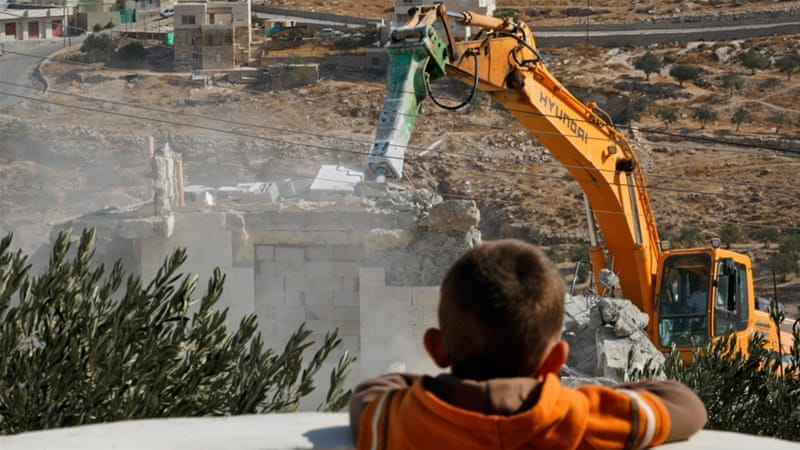
A Palestinian boy looks on as municipality workers demolish a house in the East Jerusalem neighbourhood of Tzur Baher, Tuesday, October 27, 2009. (AP Photo/Dan Balilty)

A new Palestinian report reveals that Israel demolished five thousand homes in Jerusalemsince 1967 as well as the demolition of neighbourhoods in the eastern part of the city.

The report, issued by the Land Research Center (LRC), also noted that the 380,000 Jerusalemite Palestinians need 2,000 new housing units annually, and that half of them today live in unlicensed homes.

Permits

According to the report, Jerusalem’s municipality has put in place a series of procedures that would make Palestinian construction in Jerusalem impossible.

  • According to UN data, Israel approved only 1.5 percent of all requests for building permits submitted by Palestinians between 2010 and 2014.
  • According to the LRC report, only 12% of Palestinian land in East Jerusalem can be used for urban development, of which only 7% is zoned for residential housing.
  • An earlier report by the Israeli NGO B’tselem confirms those findings, saying that “some 15% of the land area in East Jerusalem (about 8.5% of Jerusalem’s municipal jurisdiction) is zoned for residential use by Palestinian residents, although Palestinians currently account for 40% of the city’s population.”
  • As of 2017, more than 20,000 housing units have been built without permits in East Jerusalem.
  • The cost of a permit is estimated at $30,000 a home.

Displacement

  • In 1948, Israeli forces demolished 39 villages around Jerusalem and displaced about 198,000 Palestinian residents.
  • The report also says that about 6,500 Jerusalemites left before the 1948 war and about 30,000 after the war.
  • 16,000 Jews were housed in homes and dwellings whose Palestinian owners were expelled between September 1948 and August 1949.
  • In 1967, 70,000 Jerusalemites were displaced, including Jerusalemites who were outside the city and were prevented from returning to it.
  • Since 2000: According to the detailed report, Israel demolished 1,706 homes between 2000 and 2017, displacing 9,422 Palestinians, including 5,443 children.

Shock: The First Crusade and the Conquest of Jerusalem

How Stephen Hawking supported the Palestinian cause

The renowned scientist, who has passed away, will be remembered not only for his work, but his support for Palestine.

Hawking made headlines in May 2013 when he decided to boycott a high-profile conference in Israel where he was scheduled to speak [File: Dan Kitwood/Getty Images]

Stephen Hawking, the world-renowned scientist who passed away on Wednesday at the age of 76, was known not only for his groundbreaking work but also for his support for Palestine.

Hawking, who had motor neurone disease, made headlines in May 2013 when he decided to boycott a high-profile conference in Israelwhere he was scheduled to speak.

The physicist was working at the Cambridge University in the UK at the time.

The Presidential Conference, an academic event held in Jerusalem, was being hosted by the late Israeli President Shimon Peres.

In a letter Hawking sent to the organisers on May 3, he said the “policy of the present Israeli government is likely to lead to disaster”.

“I accepted the invitation to the Presidential Conference with the intention that this would not only allow me to express my opinion on the prospects for a peace settlement but also because it would allow me to lecture on the West Bank.

“However, I have received a number of emails from Palestinian academics. They are unanimous that I should respect the boycott. In view of this, I must withdraw from the conference.

“Had I attended, I would have stated my opinion that the policy of the present Israeli government is likely to lead to disaster,” the letter read.

And, with the approval of Hawking, the British Committee for Universities of Palestine, an organisation of UK-based academics to support the academic boycott of Israel, said in a statement at the time: “This is his independent decision to respect the boycott, based upon his knowledge of Palestine, and on the unanimous advice of his own academic contacts there.”

Hawking’s decision was widely celebrated by Palestinian activists and academics.

“Palestinians deeply appreciate Stephen Hawking’s support for an academic boycott of Israel,” Omar Barghouti, a founding member of the Boycott, Divestment, Sanctions movement (BDS), said.

“We think this will rekindle the kind of interest among international academics in academic boycotts that was present in the struggle against apartheid in South Africa.”

Ali Abunimah, a Palestinian-American journalist, wrote: “When we look back in a few years, Hawking’s decision to respect BDS may be seen as a turning point – the moment when boycotting Israel as a stance for justice went mainstream”.

Support for Palestinian students

Hawking’s sympathy with the Palestinian cause extended beyond a boycott of Israel.

Last year, he asked his millions of Facebook followers to contribute financially to the Palestinian Advanced Physics School – a physics lecture series for masters students in the occupied West Bank.

“I support the rights of scientists everywhere to freedom of movement, publication and collaboration,” he wrote.

Screenshot from Stephen Hawking’s official Facebook page calling on his followers to raise funds

Hawking also publicly congratulated in a video on his Facebook page Hanan al-Hroub, a Palestinian woman who won the Global Teacher Prize for 2016.

“You are inspiration to people everywhere,” he said.

“In a society torn apart by conflict, where children are regularly exposed to violence, Hanan Al Hroub is building trust and supporting children suffering psychological trauma – from the heart of her classroom.”